
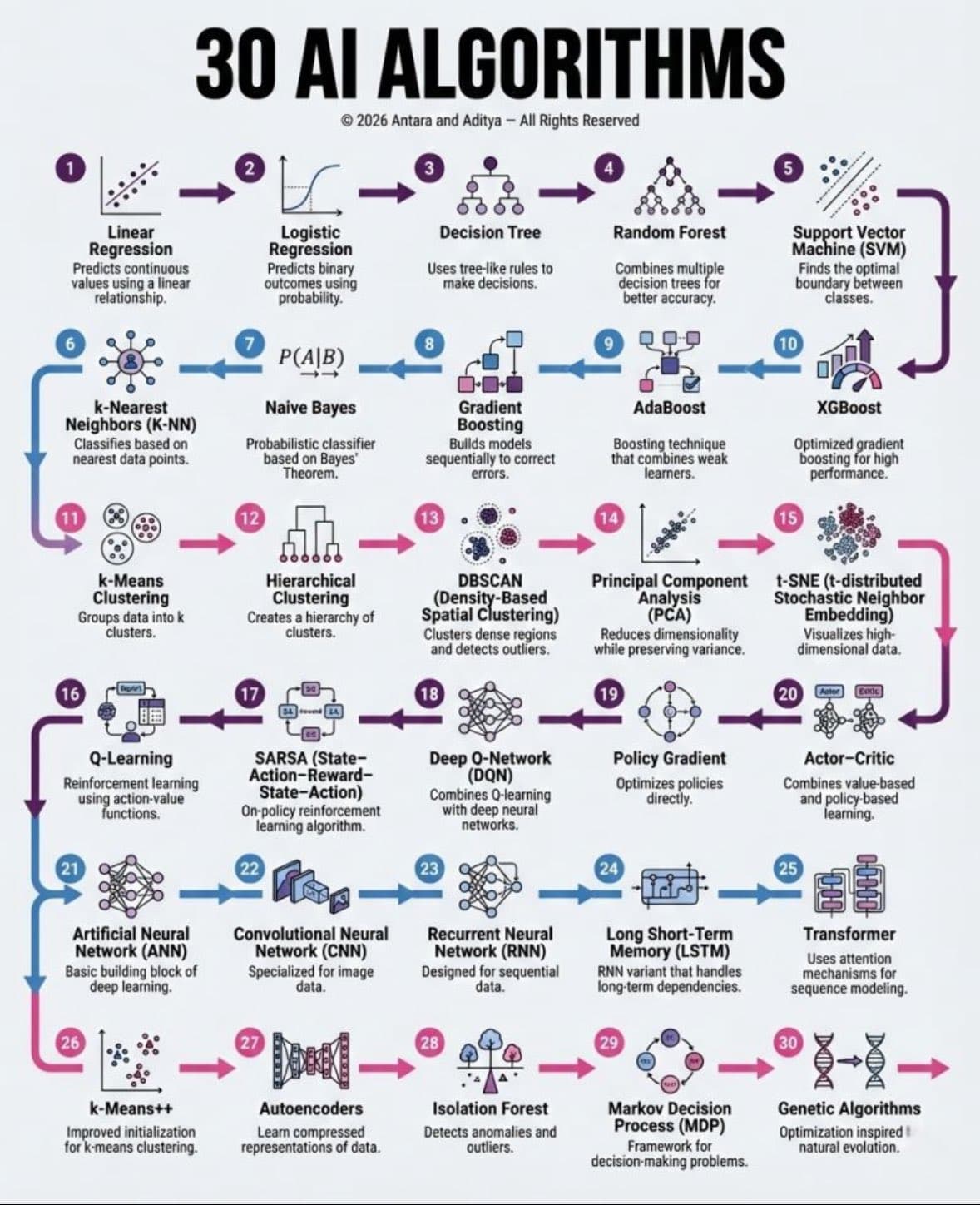
AI is not magic.
It’s structured mathematics, probability, optimization, and decision theory packaged into systems that learn from data.
Whether you’re building:
A startup
A security platform
A recommendation engine
Or the next AI infrastructure layer
These 30 algorithms form the foundation.
Let’s break them down clearly — with practical context.
🧮 Supervised Learning (Prediction & Classification)
1️⃣ Linear Regression
What it does: Predicts continuous values using a linear relationship.
Math idea: Fits a line minimizing squared error.
Used for:
Revenue prediction
Risk scoring
Forecasting
Security use case: Predicting anomaly score trends over time.
2️⃣ Logistic Regression
Despite the name, this is a classification algorithm.
Used for:
Fraud detection
Spam filtering
Binary decision systems
It outputs probability using the sigmoid function.
🌳 Tree-Based Models (Structured Decision Logic)
3️⃣ Decision Tree
Breaks decisions into rule-based splits.
Strength: Interpretable
Weakness: Overfitting
Great for:
Risk classification
Explainable AI systems
4️⃣ Random Forest
Ensemble of decision trees.
Reduces overfitting by averaging multiple trees.
Security use case: Intrusion detection models.
5️⃣ Support Vector Machine (SVM)
Finds the optimal boundary (hyperplane) between classes.
Powerful in high-dimensional spaces.
Used in:
Text classification
Bioinformatics
Malware classification
📏 Distance & Probability-Based Models
6️⃣ K-Nearest Neighbors (KNN)
Classifies based on closest data points.
Simple but computationally heavy at scale.
7️⃣ Naive Bayes
Based on Bayes’ Theorem.
Assumes feature independence.
Extremely fast for:
Email spam detection
Text categorization
🚀 Boosting (Error-Correcting Systems)
Boosting builds models sequentially to correct previous mistakes.
8️⃣ Gradient Boosting
Strong performance for structured data.
9️⃣ AdaBoost
Focuses on misclassified samples.
🔟 XGBoost
Optimized gradient boosting.
Dominates:
Kaggle competitions
Financial modeling
Risk systems
If you’re building production ML systems, you will encounter XGBoost.
📊 Clustering & Dimensionality Reduction
These work without labels.
1️⃣1️⃣ K-Means
Groups data into K clusters.
Used for:
Customer segmentation
Pattern grouping
1️⃣2️⃣ Hierarchical Clustering
Builds cluster trees.
1️⃣3️⃣ DBSCAN
Density-based clustering.
Excellent for:
Outlier detection
Fraud detection
1️⃣4️⃣ PCA (Principal Component Analysis)
Reduces dimensionality while preserving variance.
Improves:
Training speed
Visualization
Noise reduction
1️⃣5️⃣ t-SNE
Used for visualization of high-dimensional embeddings.
Often used in:
AI research
Feature exploration
🎮 Reinforcement Learning (Decision Optimization)
These algorithms learn by interacting with environments.
1️⃣6️⃣ Q-Learning
Learns optimal action-value functions.
1️⃣7️⃣ SARSA
On-policy reinforcement learning.
1️⃣8️⃣ Deep Q Network (DQN)
Combines Q-learning with neural networks.
Used in:
Game AI
Robotics
1️⃣9️⃣ Policy Gradient
Optimizes policies directly.
2️⃣0️⃣ Actor-Critic
Combines value-based and policy-based learning.
This architecture powers modern RL systems.
🤖 Deep Learning Architectures
These power modern AI.
2️⃣1️⃣ Artificial Neural Network (ANN)
Basic deep learning building block.
2️⃣2️⃣ Convolutional Neural Network (CNN)
Specialized for image processing.
Used in:
Facial recognition
Medical imaging
Computer vision
2️⃣3️⃣ Recurrent Neural Network (RNN)
Handles sequential data.
2️⃣4️⃣ LSTM
Improved RNN for long-term dependencies.
Used in:
Speech recognition
Time-series forecasting
2️⃣5️⃣ Transformer
Uses attention mechanisms.
Powers:
Large Language Models
Modern NLP systems
AI copilots
If you’re building AI in 2026, understanding Transformers is non-negotiable.
🧬 Optimization & Advanced Systems
2️⃣6️⃣ K-Means++
Better centroid initialization for clustering.
2️⃣7️⃣ Autoencoders
Learn compressed representations.
Used for:
Feature extraction
Anomaly detection
Representation learning
2️⃣8️⃣ Isolation Forest
Specifically built for anomaly detection.
Security gold.
2️⃣9️⃣ Markov Decision Process (MDP)
Mathematical framework for decision-making under uncertainty.
Foundation of reinforcement learning.
3️⃣0️⃣ Genetic Algorithms
Optimization inspired by natural evolution.
Used in:
Hyperparameter tuning
Search problems
Engineering optimization
🛡️ If You’re Building Security Systems (Important)
If you’re building something like:
Threat detection systems
AI monitoring agents
Autonomous security tools
Intelligent logging systems
Focus on:
Random Forest
XGBoost
Isolation Forest
Autoencoders
Transformers
These are extremely relevant for anomaly detection and intelligent defense systems.
🚀 How to Actually Learn These
Do NOT try to master all 30 at once.
Phase 1 (Foundation)
Linear Regression
Logistic Regression
Decision Trees
Neural Networks
Phase 2 (Production-Level ML)
Random Forest
XGBoost
PCA
CNN
Phase 3 (Advanced Systems)
Transformers
Reinforcement Learning
Autoencoders
Anomaly Detection models
Final Thoughts
AI is not about memorizing algorithms.
It’s about understanding:
Optimization
Probability
Data structures
System design
The real power comes when you combine algorithms with infrastructure.
The future belongs to engineers who understand both models and systems.